To reach their price point of <$60/MWh, unless you've heard differently.
Helion Energy to demonstrate net electricity production by 2024
Re: Helion Energy to demonstrate net electricity production by 2024
Last edited by baking on Tue Dec 30, 2025 3:48 am, edited 1 time in total.
Re: Helion Energy to demonstrate net electricity production by 2024
your link says 60, not 6
also 400 SF would be smaller than my bedroom, don't think anyone needs a 50MWe fusion reactor quite that tiny:)
maybe for HEO you could get close to that, given that you only need a small fraction of the shielding
at any rate the economics are going to be driven by the simplicity of the design (no cryo, no SC, no drive current) as much as the size
hard to say how much diagnostic junk they can eventually remove or what the post-Orion form factor will look like, but remember their philosophy is to churn out reactors like airliners
n*kBolt*Te = B**2/(2*mu0) and B^.25 loss scaling? Or not so much? Hopefully we'll know soon...
Re: Helion Energy to demonstrate net electricity production by 2024
$60/MWh would be $.06/kWh, which sounds good. However, that estimate was in 2014. Have they revised it since then?
- Jim Van Zandt
Re: Helion Energy to demonstrate net electricity production by 2024
My bad, that was a typo. It should be <$60/MWh.TallDave wrote: ↑Mon Dec 29, 2025 4:53 pmyour link says 60, not 6
also 400 SF would be smaller than my bedroom, don't think anyone needs a 50MWe fusion reactor quite that tiny:)
maybe for HEO you could get close to that, given that you only need a small fraction of the shielding
at any rate the economics are going to be driven by the simplicity of the design (no cryo, no SC, no drive current) as much as the size
hard to say how much diagnostic junk they can eventually remove or what the post-Orion form factor will look like, but remember their philosophy is to churn out reactors like airliners
400 SF is the size of a standard shipping container, which was their original goal. (Actually, 40x8 or 320 SF, but I was being generous.) I don't think it is still practical, but I was trying to pin down Skipjack to quantify what he meant by "They will get a lot simpler and cheaper to build over time."
And I did the math wrong: 400 sf to 100,000 sf for a 50MWe power plant is 250X, not 2500X.
For comparison, a GW data center is about 4 million square feet in size. At 100,000 sf per 50MWe the GW power plant would be 2 million square feet.
Capital cost is also proportional to size.
-
Munchausen
- Posts: 297
- Joined: Mon Sep 17, 2007 5:36 pm
- Location: Nikaloukta
Re: Helion Energy to demonstrate net electricity production by 2024
The Orion building is said to be 100 x 275 feet:baking wrote: ↑Tue Dec 30, 2025 12:50 amMy bad, that was a typo. It should be <$60/MWh.TallDave wrote: ↑Mon Dec 29, 2025 4:53 pmyour link says 60, not 6
also 400 SF would be smaller than my bedroom, don't think anyone needs a 50MWe fusion reactor quite that tiny:)
maybe for HEO you could get close to that, given that you only need a small fraction of the shielding
at any rate the economics are going to be driven by the simplicity of the design (no cryo, no SC, no drive current) as much as the size
hard to say how much diagnostic junk they can eventually remove or what the post-Orion form factor will look like, but remember their philosophy is to churn out reactors like airliners
400 SF is the size of a standard shipping container, which was their original goal. (Actually, 40x8 or 320 SF, but I was being generous.) I don't think it is still practical, but I was trying to pin down Skipjack to quantify what he meant by "They will get a lot simpler and cheaper to build over time."
And I did the math wrong: 400 sf to 100,000 sf for a 50MWe power plant is 250X, not 2500X.
For comparison, a GW data center is about 4 million square feet in size. At 100,000 sf per 50MWe the GW power plant would be 2 million square feet.
Capital cost is also proportional to size.
https://x.com/Dkirtley/status/2001698046288236890
or 30,48 x 83,82, roughly 31 x 84 meters. In larger installation you will have centralized access roads and should be able to put three such buildings in a hectare.
That makes about about 7 hectares for a gigawatt of installed power. A minuscule installation even of you add in a an electrical substation, a workshop, a restaurant and an office building.
Smallest possble land requirement of just about any power source I should say.
For comparison the Forsmark nuclear power plant in Sweden (roughly 3500 megawatts of power) is about 1400 x 1300 meters (about 180 hectares) counting only the reactor buildings, the electrical substation, the workshop and the central cooling canal.
Add to that an office building, a restaurant, a huge parking lot, service personell hotel area, a cooling pond, an auxiliry gas turbine power station, process water supply facility, recreational and fish research facilities and quite a substantial harbour.
Re: Helion Energy to demonstrate net electricity production by 2024
that's the reactor, not the caps and plant and shielding and so forthbaking wrote: ↑Tue Dec 30, 2025 12:50 am
400 SF is the size of a standard shipping container, which was their original goal. (Actually, 40x8 or 320 SF, but I was being generous.) I don't think it is still practical, but I was trying to pin down Skipjack to quantify what he meant by "They will get a lot simpler and cheaper to build over time."
And I did the math wrong: 400 sf to 100,000 sf for a 50MWe power plant is 250X, not 2500X.
For comparison, a GW data center is about 4 million square feet in size. At 100,000 sf per 50MWe the GW power plant would be 2 million square feet.
Capital cost is also proportional to size.
standard shipping goes 53 foot on US rail, believe it goes 9.5 high max 4000 cubic feet... from what I have heard they would like to fit into that eventually but it's kind of a stretch goal

obviously today they're using 90-foot silica tubes, so that would require spin polarization or other upgrade to reduce the collision energy requirements
capital cost is proportional to mass and volume, not surface area... these things are much longer and skinnier than they are tall, and in theory you could even stack them
and electricity comes right out of them like magic, with no steam turbine, no blanket, no cryo, no superconductors... it is frankly ridiculous
n*kBolt*Te = B**2/(2*mu0) and B^.25 loss scaling? Or not so much? Hopefully we'll know soon...
Re: Helion Energy to demonstrate net electricity production by 2024
Nuclear fission plant components (reactor vessels, turbines, generators, heaters, condensers, cooling towers, etc) are extremely long lead items with no shortcuts, in sharp contrast to the components of Helion’s fusion generator. The point is time to make, deliver, install Helion’s fusion generators are all relatively short. Talk of capital is just about money, but **time** to online is everything in the AI race. Everything I have seen in Helion’s machine is capable to be made short term.
Counting the days to commercial fusion. It is not that long now.
Re: Helion Energy to demonstrate net electricity production by 2024
The ultimate goal is 1 cent/kWh. Why would the sf of the full plant of all things affect the cost that much?
The machine itself is much smaller and that is the important part because it allows for road transport. The rest can also be shipped in containers.
Re: Helion Energy to demonstrate net electricity production by 2024
At this point Helion Energy clearly differentiates its approach in the conversion to electric power which especially effects heat rejection & conversion capital cost plus siting, with economic, regulatory, & location restriction being flow on significant factors. Of course length of time required for manufacture is also a huge consequence when forging of heat conversion equipment is considered for approaches without direct plasma to electric power & rely on heat cycle method of conversion. On the other hand, conversion of retiring fossil plants can mitigate some of these factors.
It will be a long time before competition between different commercial fusion alternatives is the chief issue, instead time to commercial will be key. Regarding time to commercial, Helion Energy looks to be a top pick with based on latest information on Zap Energy, Zap also looks to be a top pick.
Happy New Year to all!
It will be a long time before competition between different commercial fusion alternatives is the chief issue, instead time to commercial will be key. Regarding time to commercial, Helion Energy looks to be a top pick with based on latest information on Zap Energy, Zap also looks to be a top pick.
Happy New Year to all!
Counting the days to commercial fusion. It is not that long now.
Re: Helion Energy to demonstrate net electricity production by 2024
Helion's latest newsletter is out. Most of it is stuff we already knew, but this might be news to people here:
For reference: Trenta was at 9 keV.Polaris has already surpassed Trenta’s plasma temperatures and FRC size, achieving thermonuclear fusion every day.
Re: Helion Energy to demonstrate net electricity production by 2024
I see the fusion cross sections for D-T and D-3He peak at about 60 and 250 keV. Have they said what temperatures their demo and power production reactors will reach?
- Jim Van Zandt
Re: Helion Energy to demonstrate net electricity production by 2024
That graph only is half the truth...
1. That's where they peak. Not necessary for Helion (or anyone else) to go that high.
2. Density matters too, especially in Helion's case.
3. Helion does not need and even does not want "ignition" (aka self heating, "burning" plasma) in their machines.
Helion is aiming for between 20 to 30 keV for D-He3.
Technically the 8+ keV ions that Trenta had were already enough for D-T electricity production.
1. That's where they peak. Not necessary for Helion (or anyone else) to go that high.
2. Density matters too, especially in Helion's case.
3. Helion does not need and even does not want "ignition" (aka self heating, "burning" plasma) in their machines.
Helion is aiming for between 20 to 30 keV for D-He3.
Technically the 8+ keV ions that Trenta had were already enough for D-T electricity production.
Re: Helion Energy to demonstrate net electricity production by 2024
you want our dear old friend Fig. 15
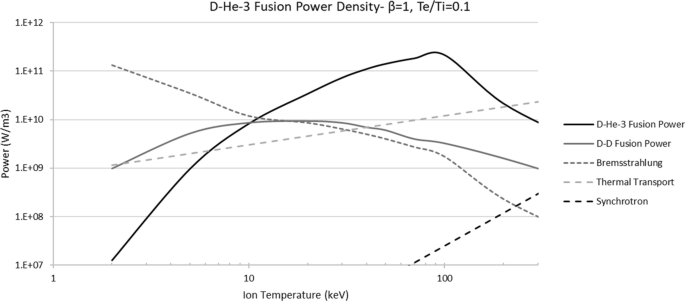
Trenta already achieved 9 KeV so that seems reasonable I guess
note we ignore self-heating due to the 14 MeV proton, which probably helps them a bit in terms of reducing the necessary magnetic compression to achieve a given peak pulse temperature... it all happens in less than a ms so some of them would still be wending through the plasma during decompression
there have been some papers claiming spin polarization could reduce these requirements quite a lot, but that's still very speculative, especially for a collided, pulsed FRC, though of course Helion is looking into it
interestingly they don't provide a D-T graph but you can actually operate their devices with D-T and produce electricity (more neutrons but also more power) it's just not nearly as clean or cheap as D-He3... the math is something like 20/80 vs 80/20 neutronicity, but at five times the power
note Slough is still arguing for D-T and he was a founder (I think Kirtley is right though)
if we assume no instantaneous losses are recovered in the decompression phase, to achieve net electric the implication is that a Polaris D-He3 pulse will peak around 20K eV (so that the total self-heating of the plasma during the length of the pulse exceeds the total losses during the pulse) and I believe they have said in the past they plan (hope?) to operate Orion at 30-40Secondly, by decreasing the electron to ion temperature ratio as shown in Fig. 15 (which has been demonstrated routinely in pulsed devices [1]), the relative fusion power to Bremsstrahlung and synchrotron radiation loss ratio increases, now requiring only a minimum of 10 keV ion temperature for net gain D–He-3 operation. It is also clear that operating D–He-3 at temperatures above 40 keV now only has marginal benefits in fusion power output.
Trenta already achieved 9 KeV so that seems reasonable I guess
note we ignore self-heating due to the 14 MeV proton, which probably helps them a bit in terms of reducing the necessary magnetic compression to achieve a given peak pulse temperature... it all happens in less than a ms so some of them would still be wending through the plasma during decompression
there have been some papers claiming spin polarization could reduce these requirements quite a lot, but that's still very speculative, especially for a collided, pulsed FRC, though of course Helion is looking into it
interestingly they don't provide a D-T graph but you can actually operate their devices with D-T and produce electricity (more neutrons but also more power) it's just not nearly as clean or cheap as D-He3... the math is something like 20/80 vs 80/20 neutronicity, but at five times the power
note Slough is still arguing for D-T and he was a founder (I think Kirtley is right though)
n*kBolt*Te = B**2/(2*mu0) and B^.25 loss scaling? Or not so much? Hopefully we'll know soon...
Re: Helion Energy to demonstrate net electricity production by 2024
They are going for 20 to 30 keV because they need 2/3 of the reactions to be D-D which favors lower temps and higher density. They can scale pretty much linearly between the two. So they can balance it to get the optimal power to breeding ratio.
IIRC, the graphs were made for 20 Tesla magnetic fields.
They CAN do D-T with their design and Polaris will demonstrate that. It is a fallback in case D-He3 fails, but they don't like it at all.
IIRC, the graphs were made for 20 Tesla magnetic fields.
They CAN do D-T with their design and Polaris will demonstrate that. It is a fallback in case D-He3 fails, but they don't like it at all.
Last edited by Skipjack on Mon Jan 05, 2026 4:51 pm, edited 1 time in total.
Re: Helion Energy to demonstrate net electricity production by 2024
The D-D reactions will yield both T and He3. Can the device be operated so they get both D-T and D-He3 reactions at the same rate, so they need not separate the two gases?
Though I suppose they plan to separate the gasses so they can sell the T to someone else, and minimize the amount of D-T fusion in their own device.
If they get much D-T fusion, those fast neutrons will deposit a lot of heat somewhere, so I suppose they'll need a lot more cooling (water jacket?). Can they still get a useful amoount of power by direct conversion, or will they need a thermal energy cycle?
By the way, I'd appreciate some clarification of the part about "lower temps and higher temperatures".
Though I suppose they plan to separate the gasses so they can sell the T to someone else, and minimize the amount of D-T fusion in their own device.
If they get much D-T fusion, those fast neutrons will deposit a lot of heat somewhere, so I suppose they'll need a lot more cooling (water jacket?). Can they still get a useful amoount of power by direct conversion, or will they need a thermal energy cycle?
By the way, I'd appreciate some clarification of the part about "lower temps and higher temperatures".
- Jim Van Zandt